
WORKING TOGETHER
to Understand
Pipeline Safety


What to expect after contacting 811…

Dig a little deeper...

Ready to dig?

Leak Recognition - Ready for the Big Bad Wolf

Pipeline Safety - We Like our Pigs Smart

Bring Home the Bacon

Contact 811 & Save Your Bacon

Whether you just want to plant some flowers, are getting ready to install drain tile, or are expanding your home, the single most important step you can take before getting covered in dirt is contacting your state's one-call notification center. It's free and required by law. Simply dialing 8-1-1 at least three days (not including weekends or holidays) before you even begin to think about rolling in the mud significantly reduces the likelihood of damage to underground facilities during excavation.
Prior to contacting 811, it's a good practice to place white marks around the area you plan to dig. This helps the professional line-locators easily identify your project area and focus the markings on the most important area — your work site.
What to expect after contacting 811…
Once a notification is made to 811, underground facility owners like CHS will come out and mark their pipes, wires, or cables using temporary paint, flags, or stakes. The markings provide guidance so that you know where it is safe to dig. This typically occurs within two to three business days after making the request for the markings. Delays can occur in this process, so it's always good to confirm that all facility owners have responded.
If you dig a little deeper...
If you dig a little deeper, there are additional steps that should be taken to protect yourself and those around you when digging.
Before you plan to roll up those sleeves and get dirty, mark sure that you have waited the required time. Double check that the utilities identified on your one-call ticket have responded to you and either confirmed that their facilities are marked or that they do not have any facilities in your project area.
You should also conduct a visual inspection to confirm that facilities have been properly marked and there are no signs of unmarked facilities such as risers, meters, valves or trench lines present.
If you spot anything unusual or just have questions, ask for help. Phone numbers for each of the facility owners are located on your one-call ticket. Reach out if you have any questions or need help. In some cases facility owners will want to be present during an excavation process. This is to ensure your safety and the protection of the underground facility.
Remember to always contact 811 again if facilities have not been marked, they become unclear, disappear because of rain or construction activity or are damaged during your project. Remember markings expire. If you are close to the expiration date, always renotify 811.
Ready to Dig?

As you start your project, don't just jump in. Starting slow and poking around a bit will help confirm that no facilities are hidden in your project area. Use non-mechanical means like a shovel to expose your project area first to confirm that nothing lurks below. This is especially important when digging on your personal property, as some of the buried pipes, wires, and cables that you are responsible for may not be marked. Property owners are responsible for what many refer to as "private" or "customer-owned" facilities. Examples of these include your cable wire or water line from the street.
Working carefully in your project area will help identify potential issues early. You can also hire a professional facility locator to mark those lines owned by you. It may cost a few dollars, but it can avoid costly repairs.
See something unexpected or is someone digging without markings?
Remember, it's always important to notify utility operators if you see unauthorized excavation activities that could endanger a pipeline or above-ground pipeline facility, or if you notice that a pipeline is exposed due to erosion or excavation near the site. An extra set of eyes is always appreciated.
The majority of CHS pipelines are located in rural areas beneath farmland.

Accidentally striking a pipeline can have lethal consequences, so it's critical for farmers and ranchers to follow appropriate safety procedures, especially contacting 811. Due to soil erosion, grading and other conditions, pipelines aren't always as deep as you think.
Even if you think you are exempt from making a locate request, 811 should always be called before doing any work that disturbs the soil, including:
- Deep tilling
- Ditching
- Soil ripping
- Installing drain tile
- Constructing fences, roads, driveways, berms, overhead or underground utilities, or other facilities
Ready for the Big Bad Wolf?

Pipelines are the safest mode of transporting the resources necessary to keep our farms running. Whether it is supplying the fuel for equipment, providing the feedstock for fertilizer or the natural gas to dry the crops, heat buildings and homes or cook up a little bacon, pipelines play a critical role. At the same time, pipeline emergencies can occur.
Make sure you know how to recognize a problem and what steps to take if an emergency occurs.
Most pipeline emergencies give off one or more indications there is a problem.
Do you See:
- Dead or discolored vegetation
- A sheen on the surface of water
- Fire coming out of or on top of the ground
Do you Smell an Odor like:
- Petroleum or gasoline
- Rotten eggs
- Burnt match
Do you Hear:
- A hissing or whistling noise
If you suspect an emergency, call 911 immediately. Then call CHS at 855-424-7747.
From a safe location, provide as much information as you can including:
- Your name and contact information
- Location (address, location of the nearest intersection or GPS coordinates) of the issue
- Description of the event
Warn others to stay away:
If the material being released from the pipeline isn't burning, take steps to prevent ignition. This includes prohibiting smoking, rerouting traffic, or doing anything that may cause a spark like starting a car, talking on a phone or even ringing a doorbell.
PIPELINE SAFETY
We like our pigs smart
Safety is at the core of everything we do. CHS uses advanced technology to protect the communities we operate in. CHS uses a safety management system framework that guides our operations by helping us identify and manage risk, setting clear safety goals, identifying and mitigating hazards, ensuring regulatory compliance and driving continuous improvement.
A key component of the CHS safety program is the use of P.I.Gs to conduct internal pipeline inspections. P.I.G. stands for Pipeline Inspection Gauge. The acronym was coined after pipeline employees heard the noise P.I.Gs make when traveling down the pipeline, which is similar to a pig squealing. This process allows CHS to detect corrosion, cracking, and dents along the pipeline without digging it up. Repairs are made based on this data provided by the P.I.G., which allows for the pinpointing of potential integrity issues.
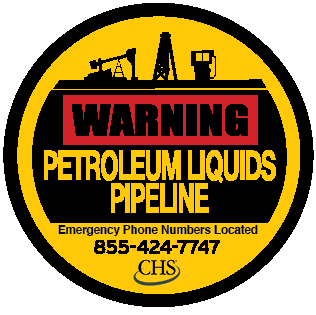
Pipelines are clearly marked with safety and contact information to raise public awareness.
Markers always provide:
- The Company Name
- The product type being transported
- A 24-hour emergency number
- The words "Danger," "Caution," or "Warning"
Other safety measures include:
Conduct regular inspections and maintenance to meet strict operating standards.
Maintaining a low-voltage electric current over its pipelines, referred to as cathodic protection, in order to prevent corrosion of the steel.
Patrolling pipeline ROW to ensure it is clear and no leaks are present, including ensuring the pipeline is accessible for ongoing maintenance and emergency response
This Little Piggy Went to Buxus®